
 1-800-667-3061
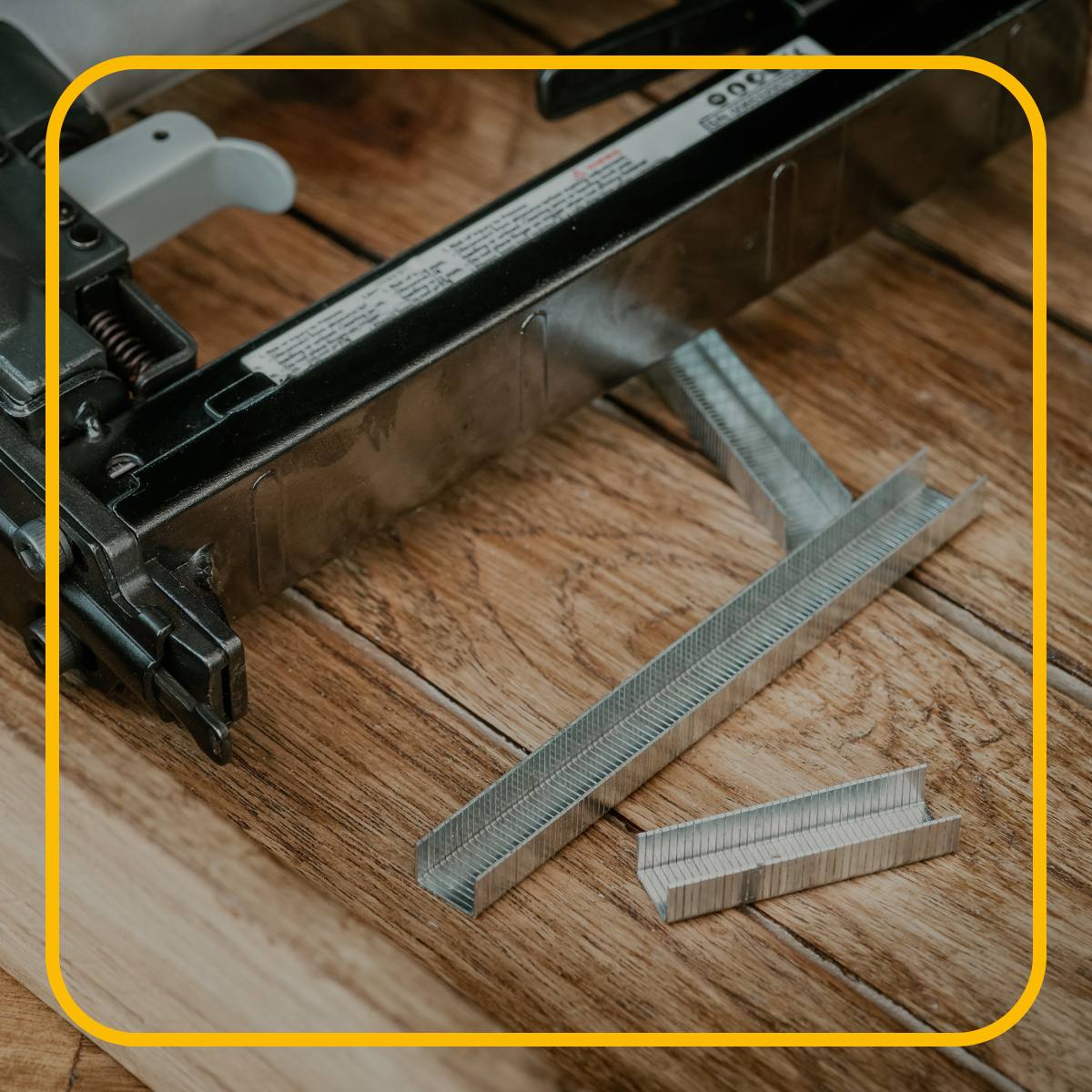
The wrong staple gauge can split your material, leave visible marks on a finished surface, or let a structural assembly fail under load, on top of weakening hold strength. The gauge system is also counter-intuitive: the higher the number, the thinner the wire. Getting it right matters more than most operators realize, and gauge is only half the decision. Crown width and point profile complete it.
How gauge affects the material
Wire diameter controls two things that often pull against each other: holding power and material integrity. A staple that's too thick in hardwood acts like a wedge, creating micro-fractures that weaken the assembly over time. A staple that's too thin in softwood won't develop the lateral tension needed to hold under stress. The right gauge maximizes pull-out resistance without compromising the material around it.
Gauge alone doesn't settle it. A 16GA staple with a medium crown behaves very differently from a 16GA with a wide crown. The wider crown spreads load across a broader surface, which matters in sheathing but works against you in finish work, where discretion is the priority. A fastener spec has to account for gauge, crown and point profile together.
The Shur-Fast staple range, gauge by gauge
Shur-Fast manufactures and imports staples from 15GA to 20GA, in medium, wide and narrow crown formats. Here is how each gauge maps to real-world applications, and which Shur-Fast product fits.
15GA medium crown: heavy-duty structural and outdoor
The thickest wire in the range. The Shur-Fast 15GA medium crown staple has a 1/2" crown and comes in a galvanized finish. It is compatible with the BCS 15S4 series and tested for use with the Bostitch 863S4-1 and JIT JQS65B staplers.
Use this gauge where you need extreme pull-out resistance: industrial pallet manufacturing, assemblies exposed to weather cycles, and pressure-treated lumber, where the fastener has to anchor deep into dense, often chemically treated wood without losing its geometry over time. The 1/2" crown gives a wide load-bearing surface that spreads stress across the grain instead of concentrating it at a single point.
16GA medium crown and wide crown: the structural workhorse
Shur-Fast offers the 16GA in two crown configurations, medium and wide, so you can match the fastener to the structural demand.
The medium crown 16GA is the standard for high-load applications: heavy furniture frames, fencing, and component assembly in hardwoods. Slightly finer than the 15GA, it balances holding power and material preservation in hard, dry wood species.
The wide crown 16GA suits applications where surface coverage matters as much as penetration: sheathing, crating and pallet assembly. The wider crown grips a broader strip of substrate, which reduces the risk of pull-through under lateral loads.
The 16GA medium crown is available in galvanized and, in the 7/16" crown, in stainless steel. The 16GA wide crown (1" crown) is available in galvanized.
17GA medium crown: the intermediate specialist
Often overlooked, the 17GA medium crown sits between the structural robustness of 16GA and the finer profile of 18GA. It works where 16GA is overkill but 18GA doesn't hold enough: medium-duty furniture assembly, cabinet carcasses, and interior structural components that won't see heavy loads.
18GA narrow crown and medium crown: precision and versatility
The most widely used gauge range in production environments, Shur-Fast's 18GA comes in two crown configurations, narrow and medium.
The narrow crown 18GA is the go-to for trim work, cabinetry and thin wood components. The narrow profile enters without splitting or telegraphing through a finished surface. Strong enough to hold, fine enough to disappear.
The medium crown 18GA grips slightly more surface than the narrow crown. That suits underlayment, light structural assembly, and jobs that need more holding surface than a narrow crown offers but can't take the weight and visibility of a 16GA.
20GA fine wire: finish and upholstery
For applications where the fastener must be invisible: decorative mouldings, fine millwork, upholstery and fabric fastening. Shur-Fast's 20GA line comes in three crown widths (3/16", 3/8" and 1/2"), compatible with the widely adopted A11 and T50 series formats.
Tested tool compatibility includes the Shur-Fast HT-11H-BL, Bostitch BTFP71875, DeWalt DWHT75900, Rapid R1 and Senco PC0700.
The 3/16" crown virtually disappears under fine leather or thin fabric, which makes it a fit for high-end upholstery. The 3/8" crown (A11/T50 standard) is the workhorse for general upholstery and light finish work. The 1/2" crown gives a broader holding surface for heavier textiles and multi-layer assemblies.
Point profiles
Gauge and crown do most of the work. The point profile closes the gap. Shur-Fast offers four point options across its staple range, each suited to a different substrate behavior.
Sharper Point (SP) is the most common point across the Shur-Fast staple line. The SP profile reduces fibre tearing in the substrate on entry, which improves both the quality of the bond and the visual result on finished surfaces. It is the default for general-purpose work.
ICC Point is designed for thinner substrates, where the staple must seat securely without blowing through. The ICC profile creates a seating pattern that increases holding power in delicate materials, particularly in 18GA and 20GA applications on thin panels, veneers and upholstery fabrics.
IC Point is for thicker substrates. It is the ideal point when clinching on a steel plate.
KO Point gives clamp-like holding power, with customizable leg lengths to suit the substrate thickness. It is best for multi-layer assemblies where fabric, foam, backing and frame must all be secured in a single shot, and it is particularly useful in 15GA and 16GA heavy-duty applications where maximum grip is non-negotiable.
What happens when the gauge is wrong
A 16GA staple driven into a thin cabinet panel can blow out the surface. A 20GA staple used in a pallet joint will pull out under the first real load. Both failures look like quality problems, but the cause is the spec. Choosing the right gauge, crown and point profile up front removes a whole category of rejects before they reach QC.
One supplier for the full range
Sourcing different gauges from different suppliers means different quality standards, different lead times, and no one to call when a problem spans two product categories. Shur-Fast covers the entire 15GA to 20GA range under one roof. Staples come in galvanized, with stainless steel offered on selected 16GA and 17GA sizes, and custom engineering is available for specific leg lengths, point geometries or packaging configurations through the Montreal facility.
When you're not sure which combination of gauge, crown and point is right for a new application, Shur-Fast's technical team works directly with your operation to spec the fastener instead of guessing from a catalogue.
Not sure which gauge is right for your application?
Talk to one of our technicians. Give us your wood species, thickness, and assembly requirements, and we'll spec the right fastener for your line.